Charging an EV From Your Roof: How Solar and a Car Work Together
An electric car can add a third to a household's electricity use. Planning the solar system around it changes the size, the savings and the best time to plug in.

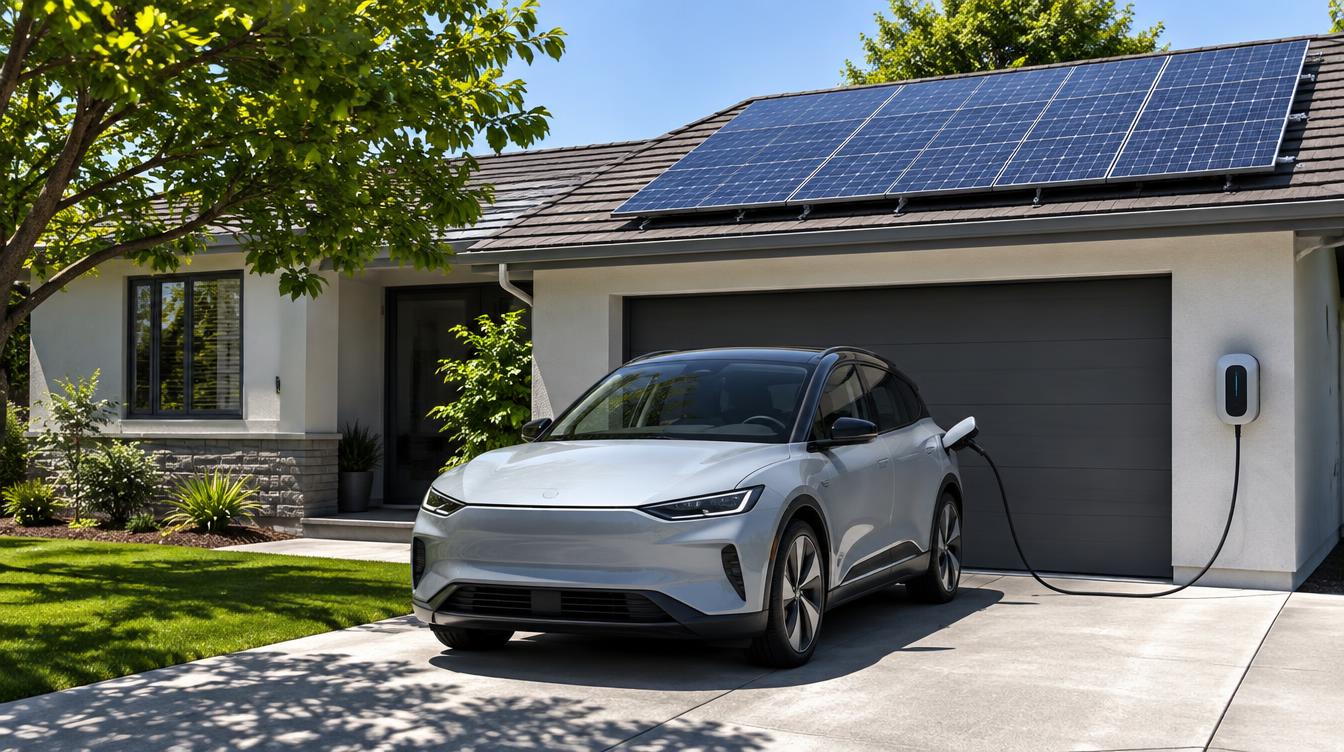
- Driving 12,000 miles a year in a typical electric car uses roughly 3,400 kilowatt-hours, or about seven extra solar panels.
- Solar produces at midday, and most cars charge at night. How your utility credits exported power decides how much that matters.
- If an EV is likely within a few years, size the solar system for it now.
Solar panels and electric cars are natural partners. One produces electricity on your roof and the other is the largest new consumer of electricity most households will ever add.
Bring them together thoughtfully and the car runs largely on sunshine. Plan them separately and you can end up with a solar system that is too small and a charging routine that misses most of its output.
How much electricity does a car use?
Electric cars are rated by how far they travel on a kilowatt-hour. Most fall between three and four miles per kilowatt-hour, with large trucks and SUVs lower.
Divide your annual mileage by that figure. At 3.5 miles per kilowatt-hour, 12,000 miles a year needs about 3,400 kilowatt-hours.
For a household using around 10,500 kilowatt-hours a year, that is roughly a third more.
How many panels is that?
A 400-watt panel in a location with average sunshine produces very roughly 500 kilowatt-hours a year, after typical system losses.
| Annual miles | Approximate energy | Extra 400 W panels |
|---|---|---|
| 8,000 | 2,300 kWh | 4 to 5 |
| 12,000 | 3,400 kWh | 6 to 8 |
| 15,000 | 4,300 kWh | 8 to 10 |
| 20,000 | 5,700 kWh | 11 to 13 |
Sunnier regions need fewer panels and cloudier ones more. Our sizing guide shows how to work out the figure for your own roof.
The timing problem
Solar panels produce most between mid-morning and mid-afternoon. Most cars are away from home at exactly that time and charge overnight.
So in many households the car does not literally run on its own solar power. The panels export electricity to the grid by day and the car imports it at night.
Whether your car runs on sunshine depends less on your roof than on your utility's rulebook.
Why your utility's rules matter
Where the utility credits exported solar at the full retail rate, the timing mismatch costs you nothing. A kilowatt-hour sent out at noon cancels one drawn at midnight.
Where exports earn much less than the retail rate, every kilowatt-hour used directly from the roof is worth more than one exported. In that case, daytime charging becomes valuable.
These policies differ by state and utility and are revised from time to time. Read the current terms before deciding how to charge.
Charging when the sun shines
If the car is at home during the day, even part of the week, charging then makes the most of your own generation.
- People who work from home can plug in late morning.
- Weekend charging can cover much of a short weekly commute.
- A second car that stays at home is an ideal daytime load.
- Most cars and chargers let you schedule a start time.
Some chargers go further and adjust the charging rate to follow surplus solar output, so the car takes only what the house is not using.
Time-of-use rates
Many utilities offer rates that are cheaper overnight and more expensive in the late afternoon and evening. Some have plans designed for electric car owners.
With such a rate, the pattern is simple: use solar directly by day, avoid the evening peak and charge the car in the cheap overnight window.
Sizing the system with a car in mind
If you already own an electric car, include its consumption when you size the solar system. A year of bills that includes the car makes this easy.
If you plan to buy one in the next few years, tell your installer. Adding panels later means a second visit, a second permit and sometimes a second inverter. It is nearly always cheaper to allow for the car at the start.
Check that the inverter and the electrical panel have capacity for the larger system and for a car charger.
The charger
A home charger on a 240-volt circuit is the usual choice. If solar-aware charging interests you, ask which chargers work with your inverter or monitoring system.
An electrician can confirm what your electrical panel will support, and our guide to home batteries explains what storage can and cannot add.
Do you need a battery?
Not for the car. Charging a car from a home battery means the energy is stored twice, with losses each time, and a typical home battery holds a fraction of what a car battery does.
A home battery earns its place for backup power and for using solar in the evening. The car is better charged directly from the panels or from cheap overnight electricity.
Powering the home from the car
Some electric vehicles can send power back to the house, turning the car into a very large backup battery. This needs a compatible vehicle, a compatible charger and usually the utility's approval.
It is a promising technology and not yet widespread. Treat it as a bonus if your chosen car and charger support it, and confirm the details in writing.
What it saves
Driving on electricity is usually cheaper per mile than petrol, and driving on your own solar electricity is cheaper again, once the system is paid for.
The exact figures depend on your utility rates, your export credits, the car and the price of fuel where you live. Work through them with your own numbers before counting on a particular saving.
The plan
Estimate the car's annual electricity use. Add it to the household total and size the solar system for both. Check your utility's export and time-of-use rules, and set a charging schedule to suit.
Get those four steps right, and the question of where your fuel comes from has a pleasingly simple answer: up there.
Frequently asked questions
How many solar panels does it take to charge an electric car?
For a typical car driven about 12,000 miles a year, roughly six to eight 400-watt panels in an area with average sunshine. The exact number depends on the car's efficiency, your mileage and how much sun your roof receives.
Can I charge my EV directly from solar panels?
In effect, yes, if the car is plugged in while the panels are producing. Some chargers can match the charging rate to surplus solar output. If the car charges at night, it draws from the grid, and the economics depend on how your utility credits the solar energy you exported during the day.
Can an electric car power my house?
Some vehicles and chargers support sending power from the car to the home. It requires compatible equipment on both sides and approval from the utility, and availability is still limited. Check carefully before relying on it.